Wednesday, April 05, 2006

How hybrid power surprised the car industry

By Jorn Madslien BBC News business reporter

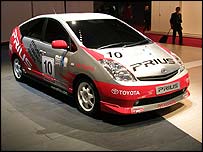
Toyota's petrol and electric hybrid model, the Prius, is more than just a car - it is a phenomenon.

And not only because it has just been voted car of the year 2005 in Europe, on top of a similar award in the USA early this year.

The car's surprise success has sparked a revolution in the car industry that is about to change forever the way the world's automotive sector operates.
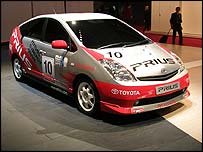
"In 20 or 40 years" all the automotive group's cars will be hybrids, the man in charge of Toyota's research and development, design and product development, Kazuo Okatmoto, told the car industry magazine Automotive News Europe.

(Picture Right: How Does It Works? A hybrid car is powered by an electric motor. The motor's battery is recharged by an electric generator which is powered by a petrol engine. Since the petrol engine runs at an optimal speed, it consumes fuel in a more efficient way than traditional petrol engines. Additional power to the battery comes from kinetic energy from the wheels when the car is slowing down. The petrol engine provides extra power for the car when required)

"And it won't just be Toyota. All makers will have hybrids," he said.

Prius stars

But these are early days.

With just 8,500 sold in Europe this year, the Prius's lofty reputation has not come about as a result of it being a best-selling model.

Rather, it has risen to the pinnacle largely thanks to endorsements from the Hollywood glitterati and their penchant for political correctness.

High profile Prius drivers such as Leonardo di Caprio, Billy Crystal, Harrison Ford and Susan Sarandon have done a world of good for hybrid cars; these days everyone who is anyone want one.

(Picture Right: DiCaprio's custom did wonders for the Prius's image)

And yet, total global Prius sales reached just 43,000 last year.

Made in Hollywood

Hollywood's enormous impact on the Prius's fortunes surprised even Toyota, which has simply been unable to deliver in sufficient numbers.

So in a rearguard action, it dramatically boosted its capacity to support the sale of 130,000 Prius next year, just over a tenth of them in Europe.


Further production facilities are being prepared outside Japan, including in China where Prius production will start next year.

And the company might even start producing the Prius in California, where Hummer-driving Governor Arnold Schwarzenegger has been prompted to swear his allegiance.

(Picturte Right: "We only have one planet," says Kevin Bacon)

Last Friday, Mr Schwarzenegger held talks with Toyota President Fujio Cho about producing Prius at the car maker's Fremont plant.

Late entrants

But if the Prius' success caught Toyota unawares, the situation was much worse for its competitors, some which have no hybrid offering at all.

Several are now desperately scrambling to catch up, with Ford and Nissan both having entered into licensing agreements that allow them to use Toyota's hybrid technology.

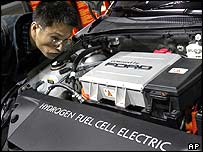
Ford's Escape Hybrid Sports Utility Vehicle hit the street earlier this year, complete with movie stars uttering statements to enhance both their own and the car's images:
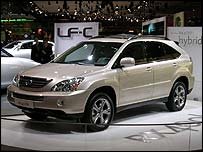
"We only have one planet," declared actor Kevin Bacon after having driven the car last April. "We have to protect this one."

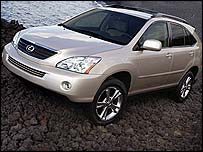
(Picture Right: Lexus unveiled its hybrid SUV earlier in year 2004)

GM, which initially had little faith in the hybrid solution, arrived late at the party, though. In Europe, meanwhile, the French car makers' stop-and-go technology has some way to catch up with Toyota.

Toyota's own efforts are also impressive: earlier this year, the car maker's luxury subsidiary Lexus unveiled its RX400h SUV and soon all Toyotas will come with hybrid engine options.

The trend is clear: the supply of hybrid cars is set to rise very fast indeed.

Read More..

Tuesday, March 07, 2006

The gas-guzzlers versus the greens

BY Bill Garrett (BBC Money Programme)

Whether you see them as gas guzzling monsters of the road or as versatile necessities of modern life, four-wheel drives have become the most controversial cars on the road, pitting environmental campaigners against car lovers and motor manufacturers.

Now the industry is fighting back by using new technology it says will improve the green credentials of their 4x4s.

(Picture Right: Many celebrities like 4x4s - especially hybrid ones)

Cars have always attracted their share of criticism from green campaigners, but expensive four- wheel drives, with their heavy fuel consumption and high carbon dioxide emissions, have become a particular target for activists in recent months. Now a group called The Alliance Against Urban 4x4s has started a campaign against their use in Britain's cities.

On a cold early morning in January this year, members of the group took to the streets of North London to leaflet parents dropping off their children on the school run.

Mums and dads driving their off-road vehicles through the narrow streets were presented with mock school reports giving bad marks for using vehicles the protestors claim are bad for the environment.

Sian Berry, one of the founders of the group, defends the tactics of the protestors. "We have been trying to point out to parents who are taking their children to school in 4x4s that they're polluting the air and they are basically making a very irresponsible choice".

Ups and downs

But the rise of the anti-4x4 protest groups spells bad news for the car industry.

These off-roaders - known as SUVs or Sport Utility Vehicles in the States - are amongst the few growth areas for the hard-pressed motor industry, and now virtually all manufacturers, from Ford to Honda, Porsche to Land Rover, include them in their model ranges.

Demand for SUVs has doubled in the UK in the last 10 years with 80,000 sold in 2004 alone, and that accounts for over 6% of all new cars sold here.

David Motton, editor of What Car?, argues that they appeal to people's desire to make their lives feel more exciting.

"Maybe you are just on the way to the supermarket, but you might feel that if the mood takes you, you could dash off to Snowdonia.

"It just gives you a sense that perhaps life might be a bit more adventurous than the humdrum life that most of us really lead."

So the big problem for the car industry is how to hold on to this profitable and glamorous sector of the market whilst appeasing the environmentalists.

Escape to victory

Ford think they might have the answer by incorporating what is known as hybrid engine technology into some of their SUVs.

Hybrid vehicles are powered by a combination of a petrol engine and an electric motor, and the effect of this dual power source is to reduce both fuel consumption and carbon emissions.

They have now launched the new Ford Escape Hybrid in the USA, the world's first commercially-available hybrid SUV.

Mary Ann Wright, head engineer for hybrid technology at Ford, believes the company is responding to the concerns of its customers.

"We love our big bodacious SUVs, but in recent years we are not feeling quite so good about driving them because of the environmental footprint that they leave. And we are looking to create a product that would appeal to the environmentally-conscious consumer and the [Ford] Escape was perfect".

But is this a genuine effort to improve the green credentials of the SUV, or simply an attempt to make it more marketable?

Last year, Lexus, the luxury offshoot of Toyota, unveiled the Lexus RX 400h hybrid off-roader at European motor shows. It will be the first hybrid 4x4 to reach the UK market later this spring.

At a cost of over £40,000 it will be considerably more expensive than its petrol-only counterpart, but Lexus is hoping that customers will be won over both by the idea of lower fuel consumption and the concept of guilt-free 4x4 motoring.

Model behaviour

John Wormald, co-author of "Time for a Model Change", an analysis of the worldwide motor industry, argues that the industry is trying hard to balance the needs of its customers against growing environmental concerns.

"It's a classic contradiction... between the interests of the individual and the interests of society or of the global community. SUV hybrids are a way of reconciling those two conflicting interests, a way of being able to keep a larger vehicle without its being quite so thirsty and polluting."

Whatever the environmental arguments, the 4x4 is undoubtedly here to stay - the motor industry has invested too much to let it become a passing fad.

Whether the anti-4x4 campaigners can ever be persuaded that greener SUVs represent a genuine concession to environmental concerns is more of an open question.

Read More..

Thursday, February 16, 2006

US prepares for hybrid onslaught


Sales of hybrid cars in the US are set to double in 2005, research suggests.

Research group JD Power estimates sales will hit 200,000 in 2005, despite higher prices and customer scepticism.

Carmakers are starting to build hybrid sports utility vehicles (SUVs), the four-wheel-drive vehicles which now dominate the US car market.

(Picture Right Above: Ford is racing to catch up on hybrids)

Hybrids cut both petrol consumption and emissions by combining a petrol engine with an electric motor constantly kept charged by extra engine power.

Several jurisdictions, notably the state of California, mandate low emissions for new cars.

Equally, the rise in oil prices over the past year has sparked hopes that consumers may be tempted by potential savings of a few hundred dollars a year on fuel.

The race is on

At the Detroit Motor Show, a range of manufacturers are prominently displaying their hybrid credentials.

Toyota has led the market to date with the Prius, popularised by a number of celebrities keen to burnish their "green" credentials.

In April it will launch a hybrid version of its luxury Lexus SUV, with a Highlander SUV due later in the year.

Honda has three hybrids on the market, and between them the two Japanese carmakers sold more than 80,000 units last year.

(Right Picture: Hollywood has taken hybrids to its heart)

Ford, which has sold 4,000 of its first hybrid since its launch in August, is bringing a hybrid SUV - the Mariner - to market a year ahead of schedule, with plans for three more models by 2008.

GM has a hybrid pickup on the market and is showing two concept SUVs in Detroit.

Even sports car maker Porsche may join the race, although it insists it is still considering whether to hybridise its Cayenne SUV.

Caution

Others remain more sceptical.

Nissan has bought Toyota's hybrid technology, but plans to bring out its first model only in 2006.

"We want to make sure we are not concentrating on one technology," Nissan chief executive Carlos Ghosn said.

"We will not be surprised by any acceleration or deceleration in the hybrid market."

Volkswagen, meanwhile, says it will focus on clean-burning diesel engines instead.

And some watchers point out that the price tag on a hybrid - upwards of $3,000 above that of an equivalent normal-engined car, and suspicion of the technology - may still cool its attraction.

"The average consumers aren't willing to pay that premium for a car they won't drive more than six years," said Anthony Pratt from JD Power.

http://news.bbc.co.uk

Read More..
Blog Widget by LinkWithin